
Skid-steer loader
What everyone calls a Bobcat, after the American manufacturer that created the category.
Its real name is the skid-steer compact loader, and it is designed from the outset to change tools several times a day.
Other names for this machine: skid-steer, skid-steer loader, mini-loader, and above all 'a Bobcat' - which is a make, not a category.
- Category
- CACES R.482A category A (compact machines)
- Status
- Direct carrier of attachments
What it does
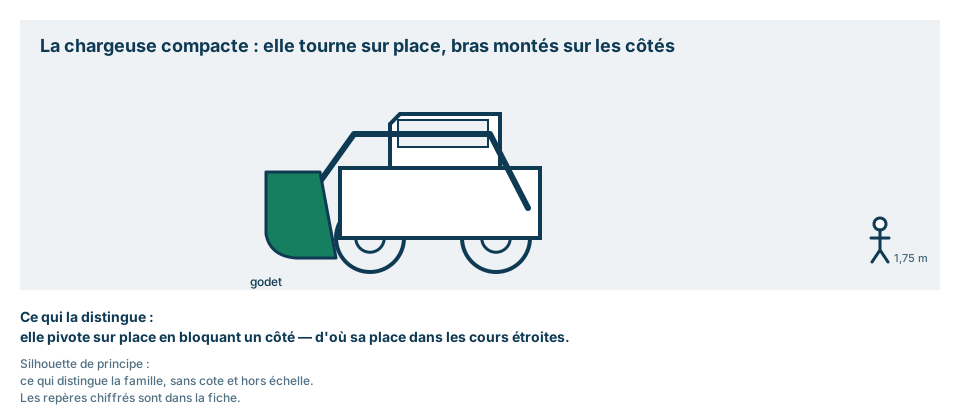
it turns on the spot by locking one side — hence its place in narrow yards.
Diagrammatic silhouette, without dimensions and not to scale.
It turns on the spot by making one side skid against the other.
Compact and quick, it is designed from the outset to change tools several times a day.
What it does not do. The skidding marks finished floors and wears the tyres.
It pushes well, it does not dig deep.

that is what gets it everywhere, and what wears the tyres.
Synthetic image.

that is why it works where nothing else gets in.
Synthetic image.
What governs the fitting of an attachment
-
The mounting plate
Most compact loaders share the same universal attachment plate, which is the reason for their versatility.
But universal does not mean identical:
the check still has to be made. -
The auxiliary hydraulic flow
Two levels exist at most manufacturers:
a standard flow, and an optional high flow.
Many tools only work with the second. - The pressure at the quick couplings It governs the force available, independently of the flow.
-
The rated operating capacity
It is the figure that manufacturers publish to say what the machine can carry safely.
It is not the weight of the machine and cannot be deduced from it. -
The overall width
It decides what will go through.
On tracks, it also depends on the width of the pads fitted.
One model, as a reference point
The values below hold for this model only.
They are there to give an order of magnitude to anyone who has none, not to serve as a reference.
- Operating weight
- 3 261 kg
- Tipping load
- 2 331 kg
- Width
- 1,641 m
- Engine power
- 74 ch
Caveat. The auxiliary hydraulic flow and the pressure do not appear on this page.
They are, however, the two figures that decide whether a hydraulic tool can be fitted:
they have to be read off on the machine.
Source. Bobcat Switzerland product page,
recorded on 1 September 2026.
These values are those of one precise model, at one precise date. They do not describe a category:
there are no characteristics of a compact loader in general, there are those of the model you have.
They change from one year to the next and never replace the data sheet of your machine.
Have your machine checked.
Give us the exact model and the work you have in mind.
We check
the coupler, the flow, the pressure and the capacity on your machine,
and we tell you what fits on it — and what does not.
Written study within 3 working days, complete file.
Tell us about your machine Written study within 3 working days, complete file · no obligation