
Mobile crane
Lifting a heavy load at a precise point, then leaving again.
It lifts; it does not work the material, and no excavator attachment fits on it.
Other names for this machine: self-propelled crane, all-terrain crane.
- Category
- CACES R.483
- Status
- Does not carry interchangeable attachments
What it does
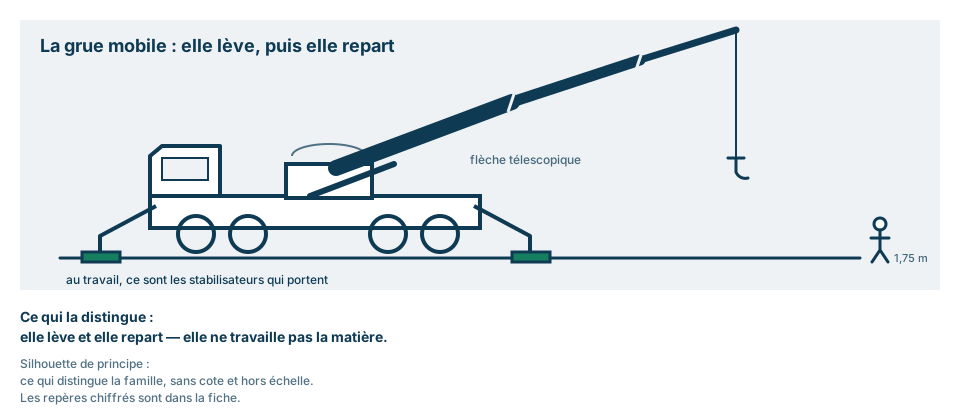
it lifts and it leaves again — it does not work the material.
Lifting a heavy load to a precise point, then leaving.
What it does not do. It lifts, it does not work the material.
No excavator attachment fits on it.

it is they that take the load, not the tyres.
Synthetic image.
What decides its use
- The volume and the distance They are what decide whether this machine has a place on the site, or whether another will do the same work for less.
- The room available A machine that cannot manoeuvre does not produce, whatever its capacity.
-
The rate of the neighbouring machines
It is rarely calculated and often costs more than the hire:
a machine that waits costs as much as a machine that works. - Transport to the worksite It governs what can actually be sent, and it is settled before everything else.
One model, as a reference point
The values below hold for this model only.
They are there to give an order of magnitude to anyone who has none, not to serve as a reference.
- Operating mass
- 36 t
- Maximum boom
- 54 m with the 16 m fly jib
- Carrier
- 3 axles, 6x4x6 configuration
- Power
- 367 kW
- Stabilisers
- 6,4 m
Caveat. The maximum lifting capacity is ambiguous in the source consulted, which announces “50 kN on one fall” — a reeving figure, not the capacity of the crane.
The designation LTM 1050 corresponds to 50 t, but I do not publish a figure I have not read at the manufacturer's.
Source. FNTP specifications published by Le Moniteur Matériels,
2008 model, recorded on 1 September 2026.
These values are those of one precise model, at one precise date. They do not describe a category:
there are no characteristics of a compact loader in general, there are those of the model you have.
They change from one year to the next and never replace the data sheet of your machine.
Have your machine checked.
Give us the exact model and the work you have in mind.
We check
the coupler, the flow, the pressure and the capacity on your machine,
and we tell you what fits on it — and what does not.
Written study within 3 working days, complete file.
Tell us about your machine Written study within 3 working days, complete file · no obligation