
Power barrow
The site dumper:
taking the spoil out of a trench or a small area.
Where the lorry cannot get in, it is either this or the barrow.
Other names for this machine: site dumper, tipping dumper, 'the dumper'.
- Category
- CACES R.482A category A or E depending on the useful capacity - criterion revised in 2025
- Status
- Does not carry interchangeable attachments
What it does
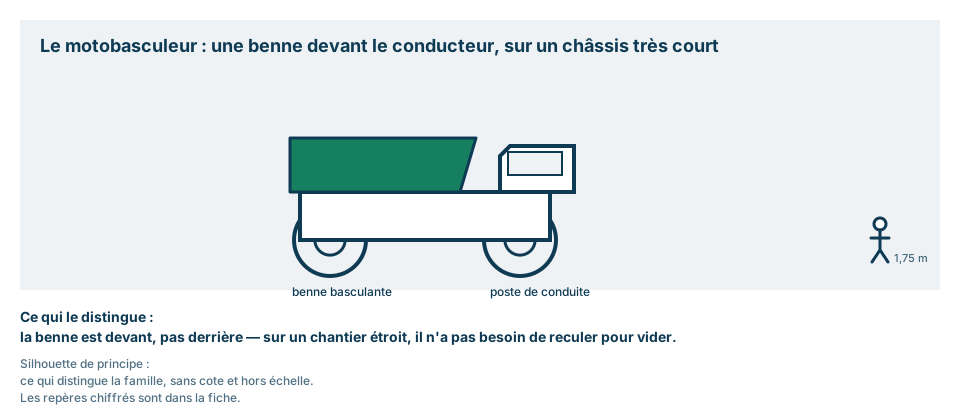
the skip is in front, not behind — on a narrow site, it does not have to reverse to tip.
Diagrammatic silhouette, without dimensions and not to scale.
Removing spoil from a trench or a small footprint, where a lorry cannot get in.
What it does not do. Small capacity, no road use.
It is a machine for a short shuttle.

where a lorry will not go, it still goes.
Synthetic image.

that is what sets it apart from a plain trailer.
Synthetic image.
What decides its use
- The volume and the distance They are what decide whether this machine has a place on the site, or whether another will do the same work for less.
- The room available A machine that cannot manoeuvre does not produce, whatever its capacity.
-
The rate of the neighbouring machines
It is rarely calculated and often costs more than the hire:
a machine that waits costs as much as a machine that works. - Transport to the worksite It governs what can actually be sent, and it is settled before everything else.
One model, as a reference point
The values below hold for this model only.
They are there to give an order of magnitude to anyone who has none, not to serve as a reference.
- Payload
- 6 000 kg
- Struck skip
- 2,700 l front-tipping, 2,350 l swivel-tipping
- Heaped skip
- 3,600 l front-tipping, 3,150 l swivel-tipping
- Operating weight
- 4,217 kg front-tipping, 4,457 kg swivel-tipping
- Engine power
- 44.5 kW as standard, 55.4 kW optional
- Overall width
- 2 230 mm
Caveat. The overall width of 2,230 mm is the real constraint:
it is what says whether the machine gets into the area, not its payload.
Source. Technical data sheet of the manufacturer Wacker Neuson,
document of 4 December 2021, recorded on 1 September 2026.
These values are those of one precise model, at one precise date. They do not describe a category:
there are no characteristics of a compact loader in general, there are those of the model you have.
They change from one year to the next and never replace the data sheet of your machine.
Have your machine checked.
Give us the exact model and the work you have in mind.
We check
the coupler, the flow, the pressure and the capacity on your machine,
and we tell you what fits on it — and what does not.
Written study within 3 working days, complete file.
Tell us about your machine Written study within 3 working days, complete file · no obligation