
Tracked hydraulic excavator
The machine this whole site is built around.
A turret that turns, an arm that articulates, a hydraulic line available at the end of the arm:
everything is made so that the tool changes and the machine stays.
Other names for this machine: mechanical shovel, digger, excavator, 'the digger'.
- Category
- CACES R.482A category B1 above 6 t; category A below
- Status
- Direct carrier of attachments
What it does
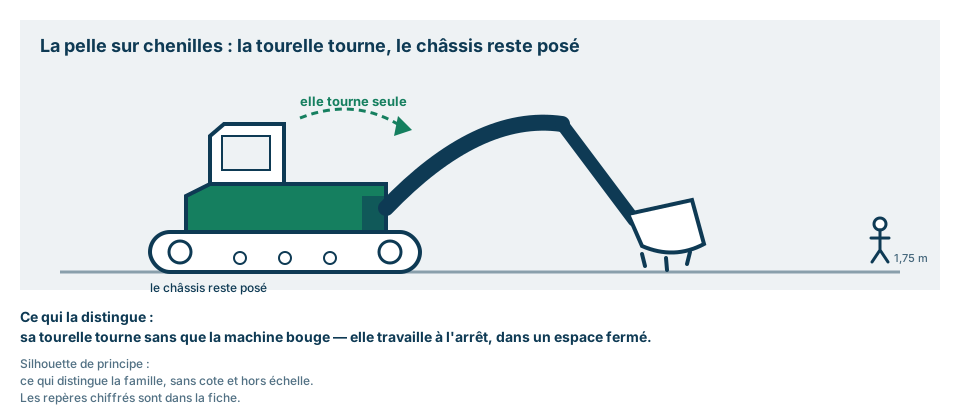
its turret turns without the machine moving — it works standing still, in an enclosed space.

the turret turning, the arm folding, and the chassis staying put.
It is the machine this whole site is built around.
Synthetic image.

it is its slewing that works, not its travel.
Synthetic image.
It digs, picks up, loads, demolishes.
Its turret turns without the machine moving, which lets it work standing still in an enclosed space.
What it does not do. It does not travel fast and it does not carry.
Over a length of work, it loses against everything else.
What governs the fitting of an attachment
-
The class of the machine
It is what bounds the permissible weight and volume of the tool.
A tool that is too heavy is not merely ineffective:
it makes the machine unstable and tires the arm. -
The coupler system
Direct mounting, mechanical, hydraulic or automatic quick coupler, and the type of the coupler itself.
It is the first thing to identify, and the one people get wrong most often. -
The flow of the auxiliary line
Expressed in litres per minute.
A hydraulic tool fed below its flow works badly; fed above it, it overheats and wears out. -
The pressure available
In bar.
The flow makes the speed, the pressure makes the force.
Both are checked, never one without the other. -
The free return to tank
Some tools, hammers and mulchers first among them, require it.
Its absence does not show on a sales sheet and is discovered when fitting. -
The lifting capacity at the working reach
It has nothing to do with the weight of the machine.
It is read on the manufacturer's load chart, at the real reach and height of the work.
One model, as a reference point
The values below hold for this model only.
They are there to give an order of magnitude to anyone who has none, not to serve as a reference.
- Operating weight
- 22,600 kg (standard boom, R2.9 arm, 1.19 m³ bucket)
- ISO 9249 power
- 128,5 kW
- Main pump
- 429 l/min (two pumps of 214.5 l/min)
- Maximum pressure
- 35,000 kPa, that is 350 bar (standard equipment)
- Pressure, heavy lift
- 38,000 kPa, that is 380 bar
Caveat. The flow of the auxiliary circuit depends on the optional equipment fitted:
it is not published on this sheet and has to be read off on the machine.
Source. Caterpillar technical data sheet, reference AFXQ2161-07,
document of September 2023, recorded on 1 September 2026.
These values are those of one precise model, at one precise date. They do not describe a category:
there are no characteristics of a compact loader in general, there are those of the model you have.
They change from one year to the next and never replace the data sheet of your machine.
Have your machine checked.
Give us the exact model and the work you have in mind.
We check
the coupler, the flow, the pressure and the capacity on your machine,
and we tell you what fits on it — and what does not.
Written study within 3 working days, complete file.
Tell us about your machine Written study within 3 working days, complete file · no obligation