
Loader crane
The crane arm mounted on the lorry that carries it.
It loads, unloads and sets down close by — and its reach falls off quickly.
Other names for this machine: lorry-mounted crane, truck-mounted crane arm.
What it does
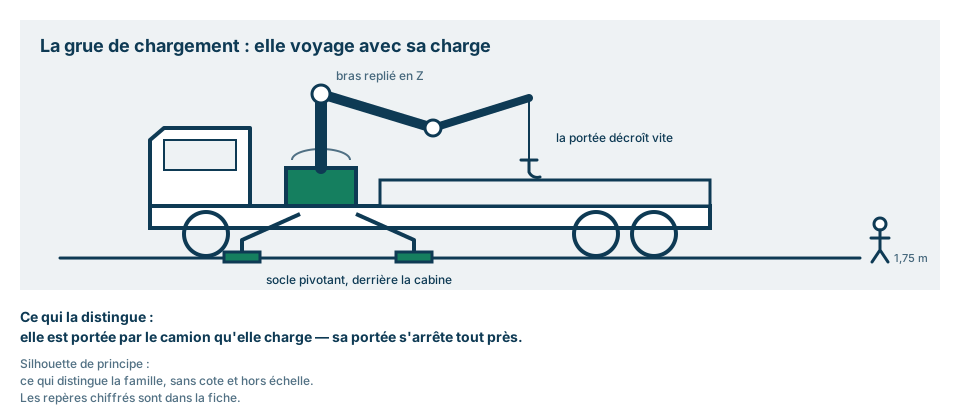
it is carried by the lorry it loads — its reach stops close by.
Loading and unloading the lorry that carries it, and placing in the immediate vicinity.
What it does not do. Limited reach and load.
It is not a site lifting machine.

the lorry arrives, unloads, and leaves again with no lifting machine on site.
Synthetic image.

no second machine on site, no waiting.
Synthetic image.
What governs the fitting of an attachment
-
The type of body
Tipper, hook-lift, flatbed:
each serves one use and rules out the others. - The lorry-mounted crane, if there is one It comes under a separate driving authorisation, and its capacity falls off sharply with distance.
-
The real payload
It is the difference between the maximum authorised weight and the weight of the equipped vehicle.
Every piece of equipment added reduces it. -
Access to the site
The lorry does not leave firm ground.
It is the constraint that decides the shuttle cycle.
One model, as a reference point
The values below hold for this model only.
They are there to give an order of magnitude to anyone who has none, not to serve as a reference.
- Lifting moment
- 23.0 as shown by the source
- Lifting capacity
- 10 000 kg
- Horizontal reach
- 8.2 to 16.7 m depending on the version
- With a fly jib
- 25,0 m
- Working pressure
- 300 bar
- Own weight
- 2,346 kg in the standard version
- Angle of rotation
- 400 degrees
Caveat. Two figures on this sheet are ambiguous and I do not correct them myself.
The lifting moment is written “23.0 tonnes” whereas a moment is expressed in tonne-metres; and the pump flow is given in gallons per minute, an American unit.
These two points are to be confirmed on the Palfinger sheet before anything goes online.
Caveat. The capacity of 10,000 kg is the maximum figure, arm retracted.
At 16.7 m reach, only a fraction of it is left:
it is the chart that governs.
Source. Product sheet published in a trade catalogue,
recorded on 1 September 2026.
These values are those of one precise model, at one precise date. They do not describe a category:
there are no characteristics of a compact loader in general, there are those of the model you have.
They change from one year to the next and never replace the data sheet of your machine.
Have your machine checked.
Give us the exact model and the work you have in mind.
We check
the coupler, the flow, the pressure and the capacity on your machine,
and we tell you what fits on it — and what does not.
Written study within 3 working days, complete file.
Tell us about your machine Written study within 3 working days, complete file · no obligation