
Site lorry
Taking the material off the site, bringing the supplies in.
On the road, nothing replaces it; off firm ground, it goes nowhere.
Other names for this machine: rigid, tipper, hook-lift, artic, lorry-mounted crane.
- Category
- HGV licence; lorry-mounted crane subject to CACES R.490
- Status
- Partial carrier
What it does
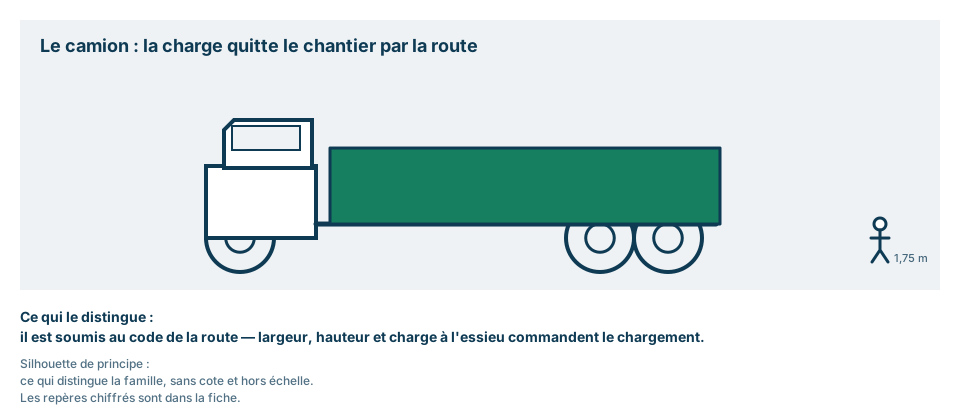
it is subject to the highway code — width, height and axle load govern the loading.
Diagrammatic silhouette, without dimensions and not to scale.
Taking the material off the site and bringing the supplies in.
On the road, nothing replaces it.
What it does not do. It does not leave firm ground.
Its lorry-mounted crane lifts, it does not work.

an excavator without a lorry stops when its heap is made.
Synthetic image.
What governs the fitting of an attachment
-
The type of body
Tipper, hook-lift, flatbed:
each serves one use and rules out the others. - The lorry-mounted crane, if there is one It comes under a separate driving authorisation, and its capacity falls off sharply with distance.
-
The real payload
It is the difference between the maximum authorised weight and the weight of the equipped vehicle.
Every piece of equipment added reduces it. -
Access to the site
The lorry does not leave firm ground.
It is the constraint that decides the shuttle cycle.
One model, as a reference point
The values below hold for this model only.
They are there to give an order of magnitude to anyone who has none, not to serve as a reference.
- D11 engine
- 330 to 460 hp, that is 246 to 338 kW
- D13 engine
- 420 to 540 hp, that is 309 to 397 kW
- Gross combination weight
- 44 to 150 t depending on the configuration
- Axle configurations
- 4x2, 4x4, 6x2, 6x4, 6x6, 8x2, 8x4, 8x6, 10x4, 10x6
Caveat. A lorry is not chosen on its power but on its axle configuration and on what the body leaves as payload.
The gross combination weight states what the whole outfit can pull, not what the body can carry.
Source. Technical specification page of the manufacturer Volvo Trucks France,
recorded on 1 September 2026.
These values are those of one precise model, at one precise date. They do not describe a category:
there are no characteristics of a compact loader in general, there are those of the model you have.
They change from one year to the next and never replace the data sheet of your machine.
Have your machine checked.
Give us the exact model and the work you have in mind.
We check
the coupler, the flow, the pressure and the capacity on your machine,
and we tell you what fits on it — and what does not.
Written study within 3 working days, complete file.
Tell us about your machine Written study within 3 working days, complete file · no obligation